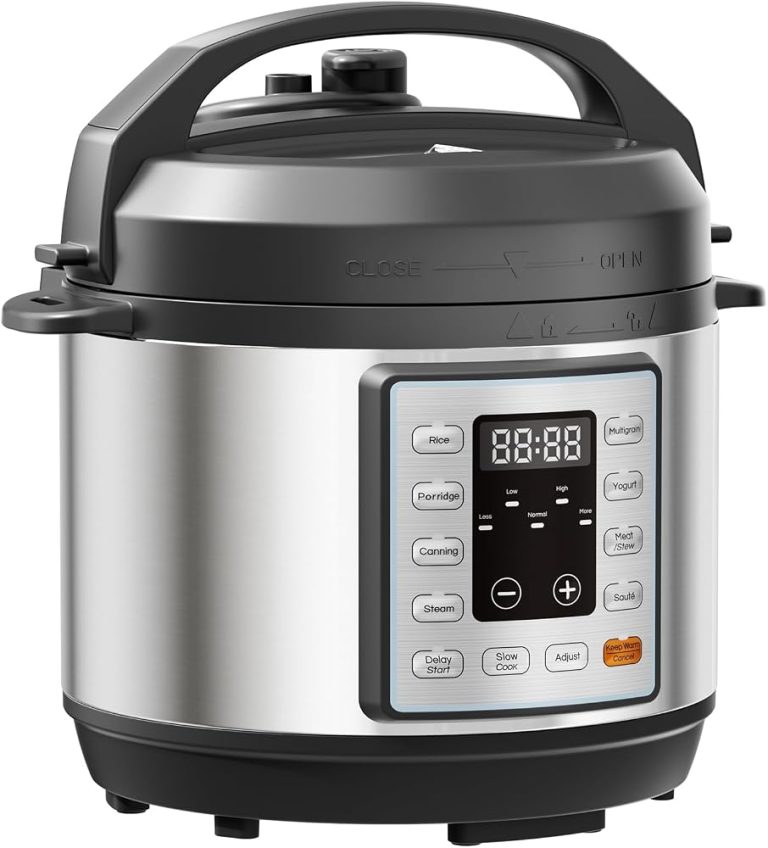
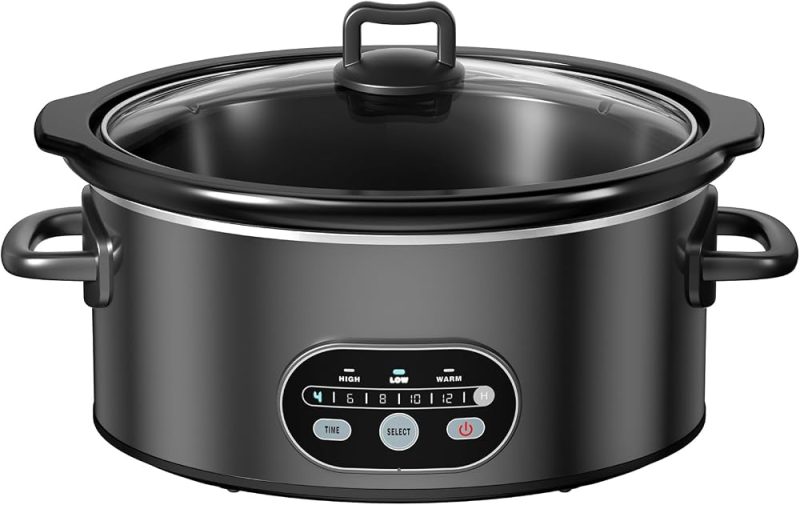
Quart size, not wattage, decides whether a pressure cooker or a slow cooker earns bench space. Buy too small and dinner runs twice; buy too large and a six quart pot overwhelms a two person kitchen. NEWBULIG lists a 3 quart electric pressure cooker at $49.99 and a 6 quart slow cooker at $34.51.
| Pot | Capacity | Price | Per quart | Watts | Dry weight |
|---|---|---|---|---|---|
| Electric pressure cooker | 3 quarts | $49.99 | $16.66 | 700 W | 7.9 lb |
| Slow cooker | 6 quarts | $34.51 | $5.75 | 240 W | 11.5 lb |
Match the quart size to the household
One quart of working volume is close to 0.95 litre, so the 3 quart cooker holds about 2.8 litres below its fill line. A 6 quart pot reaches roughly 5.7 litres instead.
One or two people eating a single meal fit the smaller pot. Four to six people, or a cook who batches stew for the freezer, need the larger one.
Price per quart reverses the obvious answer. Per quart of capacity the small cooker costs $16.66. At $5.75 per quart, the 6 quart slow cooker returns far more volume for each dollar spent.
Rice, stew and steamed vegetables all fit inside the smaller pot, which is the use case its own listing names. A larger pot does the same job and takes longer to fill.
Wattage sets the heating speed
Watts decide how fast each pot reaches temperature. The pressure cooker draws 700 watts against 240 watts for the slow cooker, a gap that shows on the clock rather than the bill.
Divide 700 by three quarts and the figure is 233 watts per quart. Divide 240 by six quarts and it falls to 40 watts per quart.
That ratio explains the whole design difference. A pressure cooker forces heat in quickly and seals it under pressure. A slow cooker releases heat gently for eight hours and will not boil dry.
Circuits are the hidden limit. A 700 watt pot on the same 15 amp circuit as a toaster and a kettle can trip the breaker at the wrong moment.
Controls differ as much as the power. A digital panel with ten presets covers rice, porridge and yoghurt in one button. Three adjustable temperatures and a push button panel handle the slow cooker. Neither panel needs a manual after the first week, though the pressure cooker lists its user manual as a boxed item.
Counter space is the number buyers forget
Bench space decides where a pot lives once the novelty wears off. The pressure cooker measures 11.02 inches wide by 10.43 inches deep, which works out at 0.80 square feet.
The slow cooker measures 16.77 inches by 11.42 inches, or 1.33 square feet, and its oval body is the harder shape to park.
Steam escapes upward while the lid is off, so a cupboard directly above the pot is a poor storage choice. Both appliances sit in the pressure cooker and slow cooker collection, and both need a socket within reach. A 35 inch cord covers most benches, though a corner run is another matter.
Full weight decides who lifts the pot
Weight only matters to the person who carries the pot to the sink. The pressure cooker weighs 7.9 pounds empty. The slow cooker weighs 11.5 pounds before any food is added.
Dry weight is the only figure the specification page states, so a full pot is heavier than the listing suggests. A 6 quart stoneware insert loaded with stew is not a one hand lift.
What a 3 quart cooker cannot do
Capacity is a hard limit, not a preference. A 3 quart pressure cooker cannot hold a chicken for four, cannot take a family batch of chilli, and cannot be filled past its line to make room.
It is also not a substitute for a slow cooker. A sealed steel pot with a slow cook button still heats differently from a ceramic insert on a low setting, so an eight hour braise will not taste the same.
Cooking for one or two people will not miss the volume. A household of five should buy the larger unit and accept the bench space that comes with it.
Cleaning and the parts that wear
Cleaning decides which pot stays in use over a year. The slow cooker’s stoneware insert and tempered glass lid are dishwasher safe, which is a large part of why the bigger unit survives a busy week.
Inside the pressure cooker, the stainless steel pot wipes clean, but its sealing ring and float valve need checking before every sealed cook.
Seals fail first. A hardened ring will not hold pressure, and replacement rings are cheap yet rarely stocked on a local shelf.
Materials separate them further. A stainless steel body in metallic silver sits against a black metal shell wrapped around a ceramic insert, and the ceramic keeps its heat after the power stops.
Buyers who want the full picture can read the slow cooker against pressure cooker and Dutch oven comparison, and the countertop cooking guide covers how much bench a second appliance really costs.
Checklist
- Count the people before the features.
- Check the price per quart, because the 6 quart slow cooker returns far more capacity for each dollar at $5.75 against $16.66.
- Measure the bench.
- Confirm the outlet reaches, since a 35 inch cord and a corner socket are not always compatible.
- Weigh the empty pot against the person who will lift it full, because 11.5 pounds becomes far more once the stoneware is loaded with stew.
- Skip both if the kitchen already runs on one hob.
Every figure here comes from the specification block on each product page. Read the capacity, wattage, weight and dimensions before ordering, then measure the bench once more. If a number does not fit the kitchen, no price will rescue it.
More buying guides
- Mirror Weight and Wall Fixings: What Holds 20 lb of GlassMirror Weight & Wall Fixings
Mirror weight decides which fixing you need long before size matters. Thirteen models run from 5.1 lb to 20 lb, and only seven publish a weight at all. Read the Included Components line before the drill comes out.
6 min read
- A 10 in Shower Head and a 51 in Faux Tree in One BathroomBathroom Corner Reach
A shower set that reaches 15 in from the wall and a 51 in artificial tree that spreads 27 in from a small pot. Both are decided by reach rather than footprint, and both need two measurements before either goes in the cart.
6 min read
- Baby Gate and Tree Swing: Height, Opening Width and LoadToddler Gate & Garden Swing
A 36 inch baby gate fits openings from 30 to 40.5 in and stands 35.63 in tall, while a 40 inch saucer swing carries 440 lb on ropes that adjust from 33.5 to 63 in. Both need one measurement before the order: the doorway gap for the gate, and a sound branch for the swing.
7 min read
- Desk Chair, Tower Heater and Mini Cooler for a Spare RoomSpare Room Workspace
Three appliances turn a spare room into a place to work: a swivel chair that needs 4.7 sq ft of floor, a 1,500 W tower heater that fills most of a 15 A circuit, and a 4 litre cooler that is not a fridge. Every size and wattage here comes from the product pages.
7 min read
- Clamp-On Forks, Hitch Adapters and Bench Kit: Fit and WeightYard Attachments & Bench Kit
Four tools that all have to fit something already owned: clamp-on pallet forks, a Category 1 hitch adapter, a 330-piece tool case and a 550 W heat press. The listing fields decide each one.
5 min read
- Automatic Pet Feeders and Travel Carriers: Capacity and FitPet Feeding & Travel
Two automatic feeders and two ways to move a pet, compared on the fields that decide the purchase: hopper litres, body weight, footprint and cable run. The numbers favour the larger hopper for two cats and the hard carrier for a small boot.
5 min read