Two buys for one household fail in different ways. A baby gate fails when the opening is measured wrong. A tree swing fails when the branch is wrong. Neither problem shows on the box, and both come down to numbers a tape measure can settle in a minute.
Start with the opening, not the gate
The gate is sold as a 36 inch model, and that figure describes height rather than width. Width comes from the frame plus two extension panels. The listing’s own dimension drawing puts the panel at 29.53 in, with extensions of 5.51 in and 2.76 in, so the working span runs from about 30 in to 40.5 in. In metric terms that is 762 mm to 1,029 mm.
Measure at three heights, not one. Skirting boards eat into the gap at floor level, and a decorative architrave can pinch the top on each side. Take the smallest of the three readings and hold it against the 30 in minimum. An opening narrower than that is not suitable for this gate, whatever the doorway looks like from standing height.
What 36 inches of gate changes
Height is where this model earns its money. The drawing gives 35.63 in from floor to top rail, which is 905 mm. Most pressure gates sit near 30 in, and the 6 in difference is precisely where a determined climber looks for a foothold. A taller frame does not make a child safe in the abstract. It puts the top rail out of easy reach.
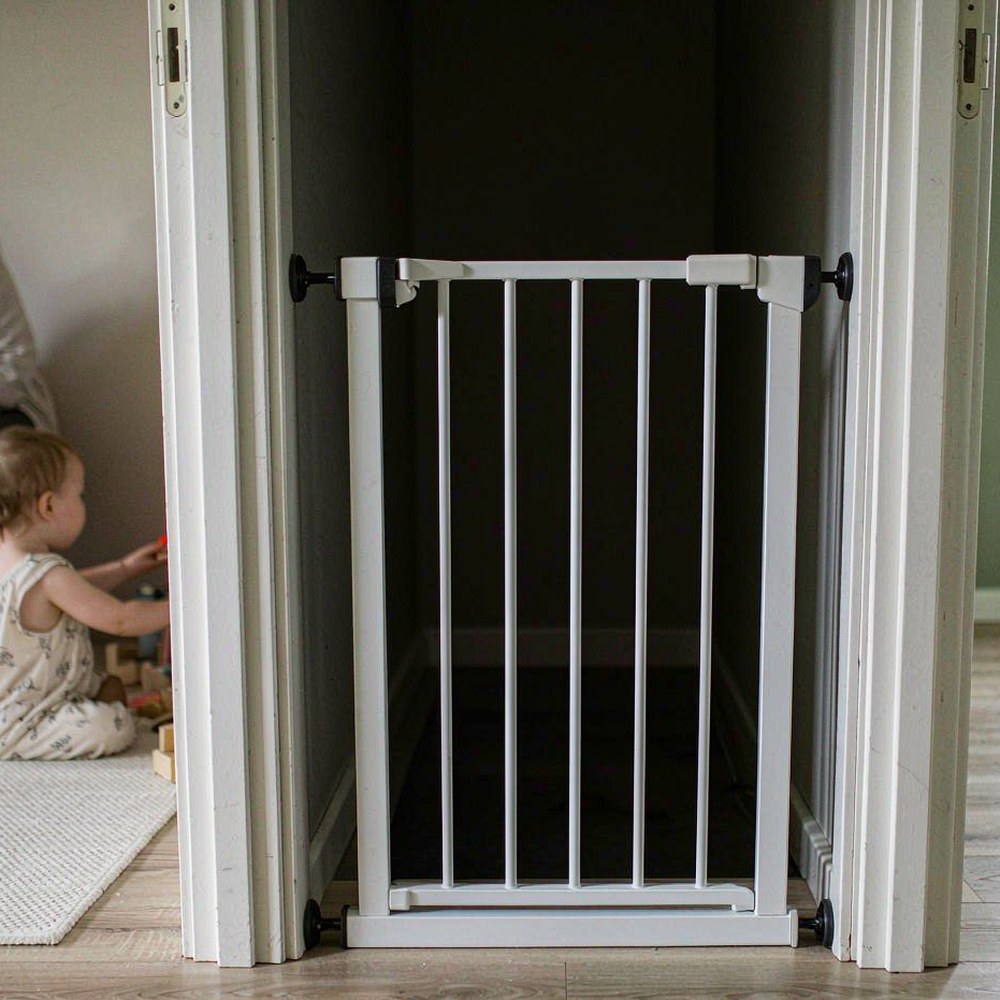
Steel construction explains the 9.5 lb (4.3 kg) figure. That mass is what keeps a pressure fit from walking out of the frame when a shoulder hits the bars. At $44.99 the gate works out at $4.74 per pound of product, and it shifts around 360 units a month, the strongest sales signal in this pair by a wide margin.
Ignore the 5.0 star rating. It rests on a single review. One review is not evidence of anything, so judge the product on the 36 in height, the 30 to 40.5 in span and the 9.5 lb weight instead, all of which can be checked before ordering.
Pressure mount or screwed bracket
The box gives both fixes. Option one is a pressure mount, where threaded pads wind out until the frame is wedged tight, with sticky pads protecting the paint. Option two uses the self-tapping screws and plastic expansion anchors supplied, and the maker’s own diagram labels that route as the one recommended for safety.
That distinction carries more weight than the marketing suggests. A pressure fit holds by friction alone, so it depends on a solid substrate and clean contact. Gloss paint, weak plaster and loose render are all poor hosts, and a gate that shifts under load is worse than no gate at all. Screwed brackets remove the variable, at the cost of four holes in the architrave.
Placement decides which option is allowed. Pressure gates are not suitable at the top of a staircase, because a child leaning on the bar pushes the whole frame outward. At the head of a run, use the screw kit. At the foot of it, or in a doorway between two rooms, pressure is fine and fully reversible.
Mechanically the thing is simple. It latches itself below 90 degrees, holds open once pushed past that, and swings through 180. The handle needs a push, a lift and a pull, which is one hand while the other arm carries a child.
The swing needs a branch, not a wall
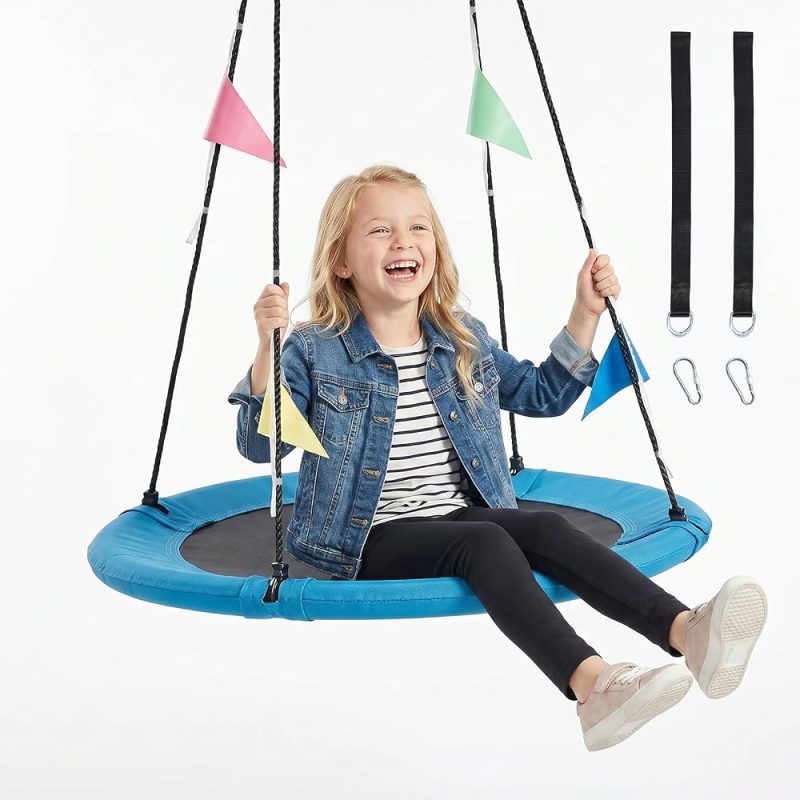
Nothing about the swing is settled until a branch is chosen. Two webbing straps wrap the limb, two carabiners clip to the ropes, and the ropes adjust from 33.5 in to 63 in, or 851 mm to 1,600 mm. That range fixes how high the seat hangs and how much of its arc clears the ground.
Pick a horizontal limb rather than an angled one. Straps creep on a slope, and a creeping strap tilts the seat. The wood also has to be alive and thick enough that webbing cannot crush the bark and girdle the branch. A dead limb is a hard no. So is a pergola beam that was never rated for a moving load.
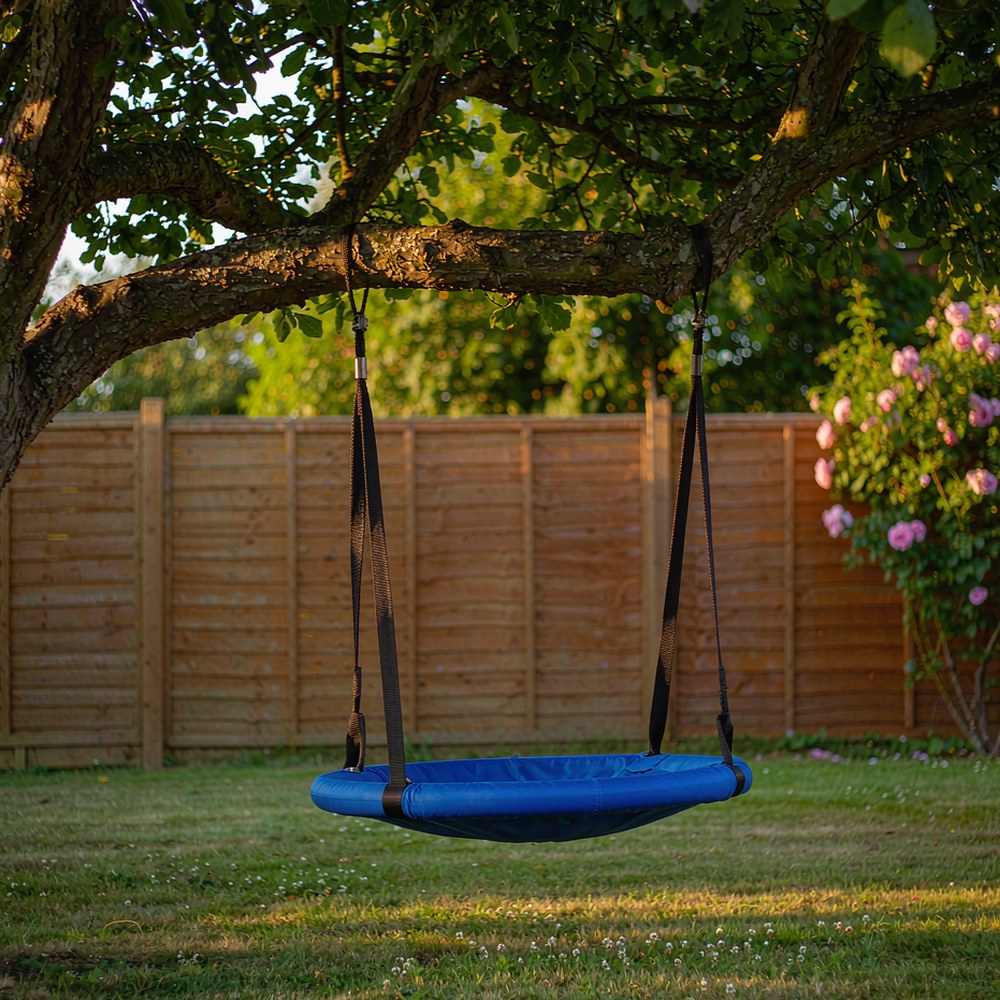
Claiming a high branch usually means standing on something, and the guide to step ladder load ratings covers which platform is safe for that job. Below the swing, the space arithmetic resembles the guide to backyard net sets, where a lawn has to hold an activity and its run-off at once.
The seat itself is a 1 m disc, since 39.37 in is 1,000 mm across. Its rim is 1.61 in deep, or 41 mm, foam padded over an iron tube, with breathable polyethylene mesh in the middle and 600D Oxford fabric around the edge. Leave a clear metre on each side before the first push.
Reading 440 lb against a real child
The rating is 440 lb, which is 200 kg. Set against the swing’s own 8.1 lb (3.7 kg), the seat is cleared to carry roughly 54 times its own mass. A 25 kg child uses about an eighth of that capacity, and two adults at 80 kg each still leave 40 kg spare.
Static capacity is not the same as a licence. A rating describes a mass hanging still, while swinging adds force at every change of direction. Treat 440 lb as headroom rather than a target, particularly where the straps meet a branch nobody has inspected since last winter.
Price lands at $24.55, or $3.03 per pound against the gate’s $4.74. Sales sit near 23 a month, well below the gate, but the rating is 4.6 from 64 reviews. That sample is big enough to carry meaning, and it is the better evidence of the two.
Where each one stops working
The gate hits a hard limit at 40.5 in of opening. Past that a third extension is required and rigidity falls away, so a wide hallway is the wrong tool for a single frame. Very tall skirting, or a wall that yields under thumb pressure, rules out the pressure route entirely. A renter who can neither drill nor trust sticky pads has no good option here.
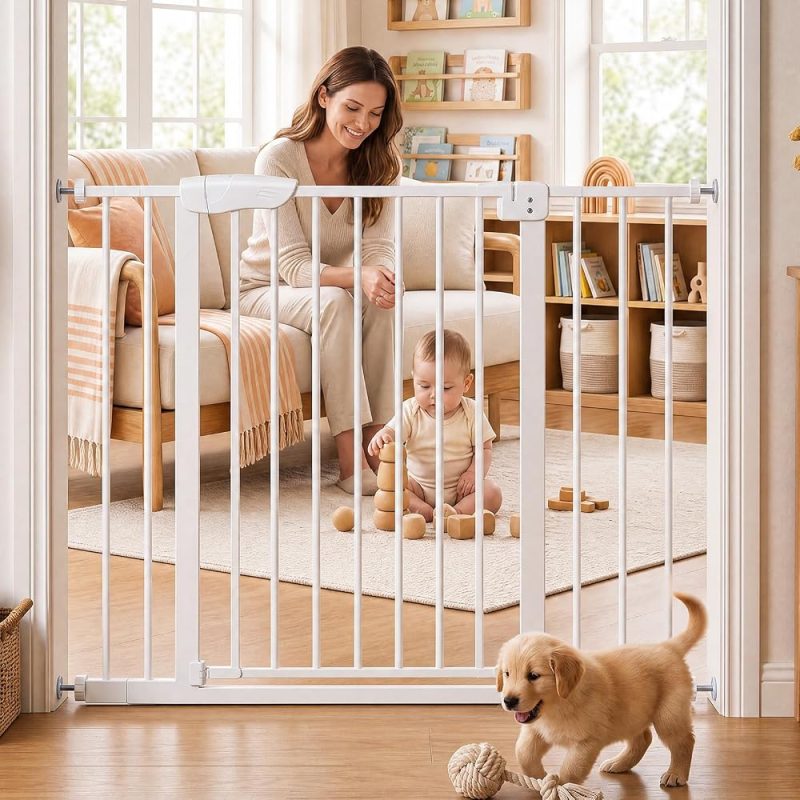
The swing cannot rescue a garden with no suitable tree. It needs one horizontal limb at a workable height and a clear drop underneath. A balcony rail is not a substitute, and neither is a shed roof. Indoors, ceiling joists have to be found and rated, which is a different project from hanging a picture frame.
Neither product substitutes for supervision. A gate buys seconds at a doorway, and seconds are the entire point. It does not convert a room into a safe room, and it will not stop a child who has worked out how to drag a stool across the floor.
| Field | 36 in baby gate | 40 in saucer swing |
|---|---|---|
| Price | $44.99 | $24.55 |
| Product weight | 9.5 lb (4.3 kg) | 8.1 lb (3.7 kg) |
| Governing size | 30 to 40.5 in opening | 33.5 to 63 in rope |
| Fixing or load | Pressure pads or four screws | 440 lb (200 kg) on a live limb |
| Rating sample | 5.0 from 1 review | 4.6 from 64 reviews |
| Monthly sales | 360 | 23 |
Checklist
- Measure the narrowest point of the opening at floor, middle and top, then compare it with the 30 in minimum.
- Decide the fixing before paying: screws at the head of a staircase, pressure pads everywhere else.
- Walk the swing’s arc with a tape measure before the carton is opened, including a metre either side.
- Choose a live horizontal limb, and reject anything that moves under hand pressure.
- Look at the branch again each spring.
- Keep the 440 lb figure in mind as capacity, never as an invitation.
Every figure here traces to one of the two product pages. Height, span, weight and price sit in the gate’s specification table and dimension drawing, while the 440 lb rating, the 33.5 to 63 in rope and the 8.1 lb weight come from the swing’s own listing. Read those fields on the page before the order goes in.
More buying guides
- Mirror Weight and Wall Fixings: What Holds 20 lb of GlassMirror Weight & Wall Fixings
Mirror weight decides which fixing you need long before size matters. Thirteen models run from 5.1 lb to 20 lb, and only seven publish a weight at all. Read the Included Components line before the drill comes out.
6 min read
- A 10 in Shower Head and a 51 in Faux Tree in One BathroomBathroom Corner Reach
A shower set that reaches 15 in from the wall and a 51 in artificial tree that spreads 27 in from a small pot. Both are decided by reach rather than footprint, and both need two measurements before either goes in the cart.
6 min read
- Desk Chair, Tower Heater and Mini Cooler for a Spare RoomSpare Room Workspace
Three appliances turn a spare room into a place to work: a swivel chair that needs 4.7 sq ft of floor, a 1,500 W tower heater that fills most of a 15 A circuit, and a 4 litre cooler that is not a fridge. Every size and wattage here comes from the product pages.
7 min read
- Clamp-On Forks, Hitch Adapters and Bench Kit: Fit and WeightYard Attachments & Bench Kit
Four tools that all have to fit something already owned: clamp-on pallet forks, a Category 1 hitch adapter, a 330-piece tool case and a 550 W heat press. The listing fields decide each one.
5 min read
- Automatic Pet Feeders and Travel Carriers: Capacity and FitPet Feeding & Travel
Two automatic feeders and two ways to move a pet, compared on the fields that decide the purchase: hopper litres, body weight, footprint and cable run. The numbers favour the larger hopper for two cats and the hard carrier for a small boot.
5 min read
- Patio Cover, Umbrella and Heater: Closing the GardenPatio Care & Heating
Three items close a patio for autumn: a 108 inch waterproof cover, a ten foot cantilever umbrella on a 17 kg base, and a 48,000 BTU propane heater. What each one measures, costs and cannot do.
6 min read