A patio closes in stages rather than in one afternoon. The cover goes on first, the umbrella comes down second, and a heater decides how many evenings remain. Three items here handle those jobs, and each one fails differently when the measuring is wrong.
Measure the table before buying the cover
The cover listed here is 108 by 82 inches, which is 2.74 by 2.08 m, with a 28 inch drop at the hem. Read that as a footprint for a table around 9 ft long and 6.8 ft wide. Buy wider and the corners hang free, so rain runs off the slack instead of the fabric.
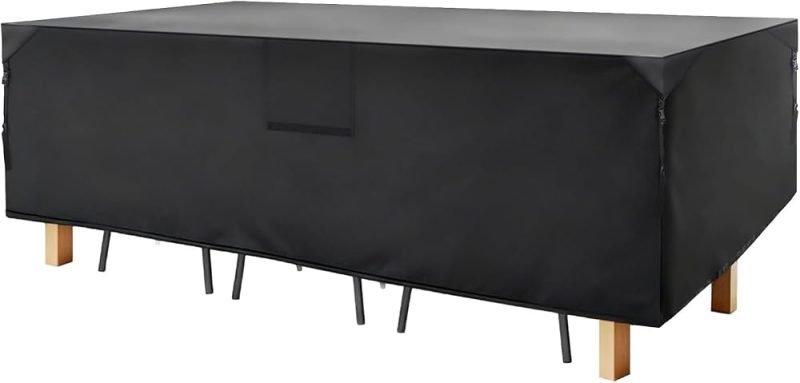
Fabric decides whether a cover survives a second winter. This one is 600 denier polyester with a PVC backing, and the whole thing weighs 4.55 kg. That weight is the reason the skirt stays down when a gust arrives from the side rather than the front.
Two buckle straps run under the legs, and an elastic cord pulls the hem tight around them. Nobody notices either feature until the first storm lifts a cheap cover over the fence and leaves the table bare.
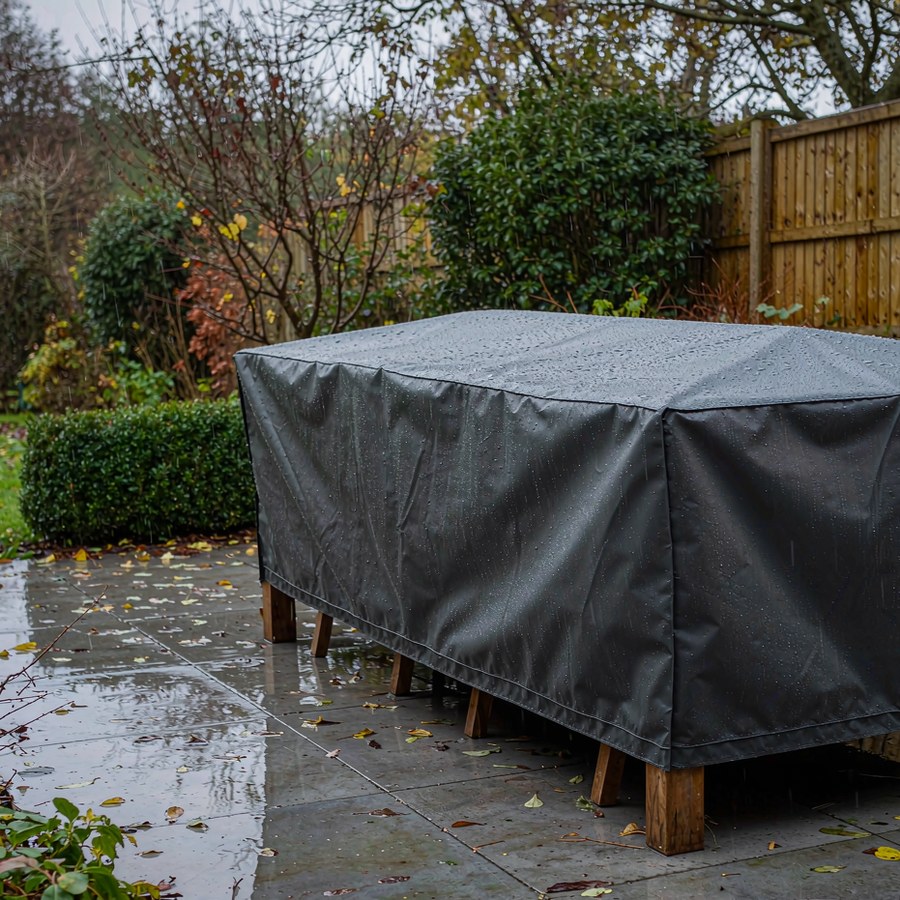
Height is the value most often ignored. A 28 inch drop suits a dining table roughly 71 cm high, and it will hang almost to the ground on a low coffee table. Measure the tallest point of the frame, not the tabletop, because chair backs usually sit above it.
Ten feet of canopy needs seventeen kilos
A cantilever umbrella solves the problem a centre pole creates: the table stays clear and nobody sits behind a mast. This one opens to 10 ft, or 3.05 m, from a single crank handle on an aluminium arm.
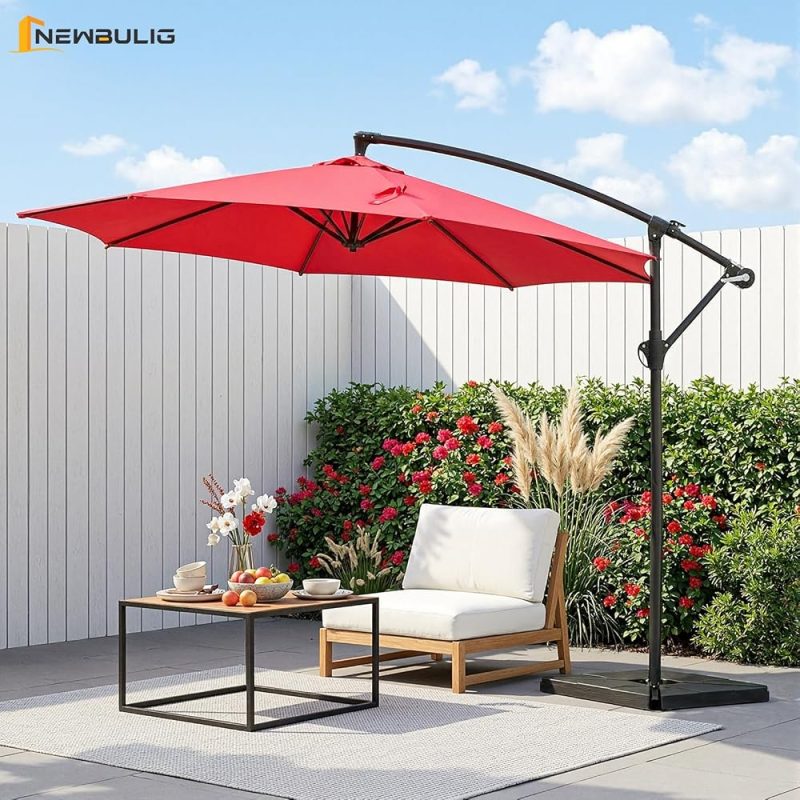
The base arrives as four separate plates and adds up to 17 kg. That is the number to check first. A 10 ft canopy catches wind like a sail, and a light base will walk across paving during an October gale.
Polyester fabric with a UV resistant finish handles the colour fastness question, and the red canopy here is the brightest option on the range. Water resistance is a coating rather than a membrane, so the fabric should be dried open rather than folded wet.
Shade geometry matters as much as canopy size. A 3.05 m canopy throws usable shade over roughly half that width once the sun drops low, which is why an offset arm needs to sit on the sunny side of the table rather than behind it.
Compare the three jobs side by side
| Item | Job it does | Key figures | Price | Rating |
|---|---|---|---|---|
| Furniture cover | Rain, leaves and UV on a frame | 108 x 82 x 28 in, 600D polyester, 4.55 kg | $27.47 | 5.0 from 37 |
| Cantilever umbrella | Sun and glare above a dining set | 10 ft canopy, 17 kg base, aluminium arm | $64.87 | 4.2 from 121 |
| Propane heater | Cold evenings in spring and autumn | 48,000 BTU, 87 in tall, 33 lb | $119.99 | 5.0 from 2 |
Order matters more than the total. Cover first, because water does the fastest damage; heater second, because warmth extends the season without touching the furniture at all.
What 48,000 BTU actually buys
Heat output is quoted in BTU, and 48,000 BTU converts to roughly 14 kW. The unit stands 87 inches tall on an 18.1 inch base, and the reflector pushes warmth downward in a cone rather than sideways across the patio.
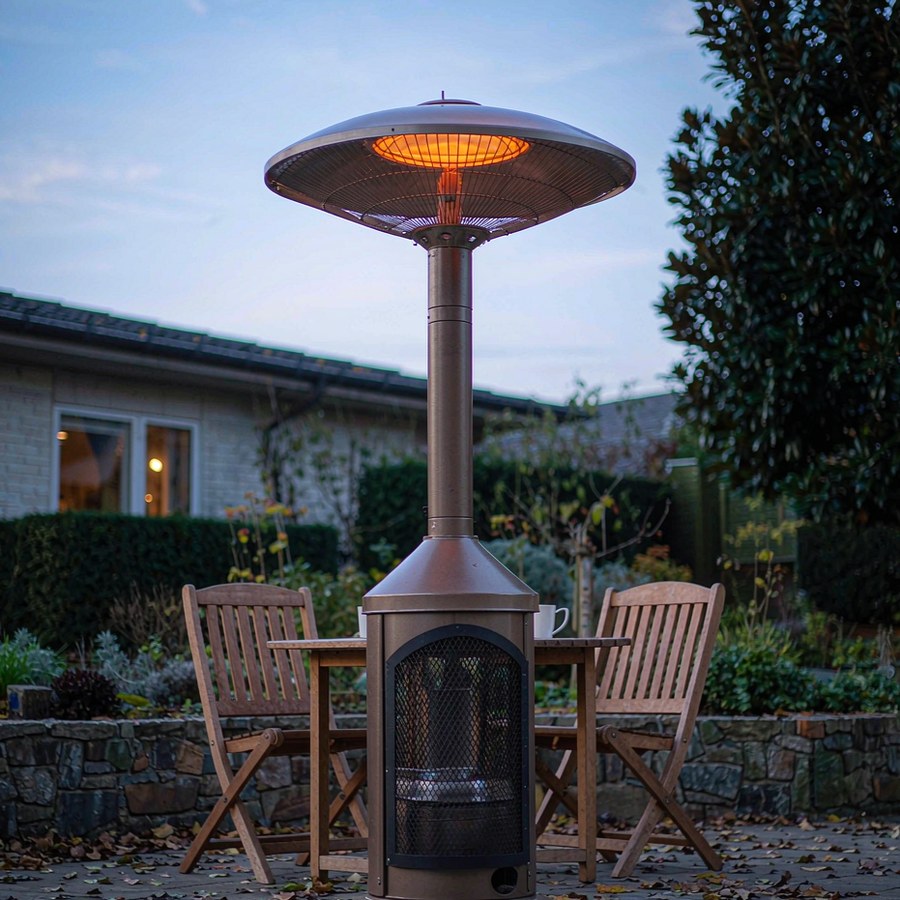
Propane is the fuel, so a cylinder is needed and none is supplied with the unit. The regulator, the hose and a wheel kit are in the carton; the gas is not.
Tip-over protection cuts the flame at 45 degrees, and the wheels let one person move 33 lb of steel without lifting it. Both features matter on a patio shared with children or a curious dog.
Placement changes the result more than output does. A heater pushed against a wall loses half its radiant field, while one standing clear of the table warms the seats on every side. Two metres of clear space above the reflector is the figure worth keeping.
Where each item stops being useful
A cover cannot dry a cushion that was already damp, and trapping moisture under PVC invites mould. Cushions belong indoors for the winter; the cover is for the frame.
A ten-foot cantilever is the wrong tool for an exposed site. The canopy should be furled whenever wind is forecast, and a furled umbrella gives no shade at all, so the table loses its purpose on the hottest afternoons.
A patio heater does not heat a garden. It warms the air close to head height, which means six people around one table will leave the far end cold. The honest comparison is a warm jacket, not central heating.
None of the three replaces shelter. On a wet November night the answer is a door, not a bigger flame.
Cost it against one season, not one summer
All three together come to $212.33, and the cover alone is $27.47. A replacement hardwood table costs many times that figure, so the cheapest item on the list carries most of the protection.
Sales volume points the same way. The umbrella moves 240 units a month, the cover 131 and the heater 58, which is 429 units across the three lines. Buyers appear to treat the cover as the first purchase rather than the last.
Ratings need reading with care. The cover holds 5.0 from 37 reviews and the heater 5.0 from just 2, which is not yet a sample worth trusting. The umbrella sits at 4.2 from 121 reviews, a figure built on far more evidence and a fairer guide to what arrives in the box.
Anyone still choosing between seating styles will find the trade-offs in the guide to zero gravity chairs, which weighs frame mass the same way this page weighs base plates.
Checklist before the first frost
- Measure the table at its widest point, including any chair backs left outside.
- Weigh the base against the canopy: 17 kg under 10 ft is the pairing sold here.
- Buy a propane cylinder before assembly day, since none ships in the carton.
- Furl the umbrella whenever wind is forecast, and let the canopy dry open after rain.
- Take the cover off during a dry spell so the frame can breathe.
- Keep cushions and textiles indoors from October onwards.
Every figure above comes from the specification panels on the three product pages: canopy diameter, base mass, cover dimensions, fabric weight, heat output, height and price. Check those fields against the current listing before ordering, because variant sizes move without notice. The garden and lawn guide covers the tools that sit alongside this kit.
More buying guides
- Mirror Weight and Wall Fixings: What Holds 20 lb of GlassMirror Weight & Wall Fixings
Mirror weight decides which fixing you need long before size matters. Thirteen models run from 5.1 lb to 20 lb, and only seven publish a weight at all. Read the Included Components line before the drill comes out.
6 min read
- A 10 in Shower Head and a 51 in Faux Tree in One BathroomBathroom Corner Reach
A shower set that reaches 15 in from the wall and a 51 in artificial tree that spreads 27 in from a small pot. Both are decided by reach rather than footprint, and both need two measurements before either goes in the cart.
6 min read
- Baby Gate and Tree Swing: Height, Opening Width and LoadToddler Gate & Garden Swing
A 36 inch baby gate fits openings from 30 to 40.5 in and stands 35.63 in tall, while a 40 inch saucer swing carries 440 lb on ropes that adjust from 33.5 to 63 in. Both need one measurement before the order: the doorway gap for the gate, and a sound branch for the swing.
7 min read
- Desk Chair, Tower Heater and Mini Cooler for a Spare RoomSpare Room Workspace
Three appliances turn a spare room into a place to work: a swivel chair that needs 4.7 sq ft of floor, a 1,500 W tower heater that fills most of a 15 A circuit, and a 4 litre cooler that is not a fridge. Every size and wattage here comes from the product pages.
7 min read
- Clamp-On Forks, Hitch Adapters and Bench Kit: Fit and WeightYard Attachments & Bench Kit
Four tools that all have to fit something already owned: clamp-on pallet forks, a Category 1 hitch adapter, a 330-piece tool case and a 550 W heat press. The listing fields decide each one.
5 min read
- Automatic Pet Feeders and Travel Carriers: Capacity and FitPet Feeding & Travel
Two automatic feeders and two ways to move a pet, compared on the fields that decide the purchase: hopper litres, body weight, footprint and cable run. The numbers favour the larger hopper for two cats and the hard carrier for a small boot.
5 min read