Loaf size, not the number of preset programmes, decides whether a bread maker earns its bench space. A two pound machine bakes a loaf that feeds five to six people, yet the same machine weighs 8.9 pounds before the flour goes in. NEWBULIG lists two stainless steel models at $69.99 and $62.99, and both share one 650 watt heating element.
| Model | Price | Capacity | Watts | Dry weight | Footprint |
|---|---|---|---|---|---|
| 21-in-1, ASIN B0HBQ6X381 | $69.99 | 2 lb | 650 W | 8.9 lb | 13 x 10 x 11 in |
| Compact 2 lb, ASIN B0HBQD9ZD7 | $62.99 | 2 lb | 650 W | 8.9 lb | 13 x 10 x 11 in |
Two pounds of dough is the real ceiling
Capacity is listed as two pounds, and that figure describes raw dough rather than the finished loaf. A baked two pound loaf comes out closer to 1.7 pounds once moisture leaves during the bake.
That ceiling maps onto a household, not a preference. A 2 pound loaf serves five to six people at roughly 4.5 ounces per slice across eight slices. Below that line the machine is doing work the oven already handles.
Three settings inside the pan change the yield. The menu offers 1.0 lb, 1.5 lb and 2.0 lb, which the listing maps to one or two people, three or four, and five or six. A smaller loaf is not a partial recipe; it is a different rise time.
Expect about 3.5 hours from mixing to the cooling rack on a standard white programme. Wholemeal takes longer because bran slows the gluten.
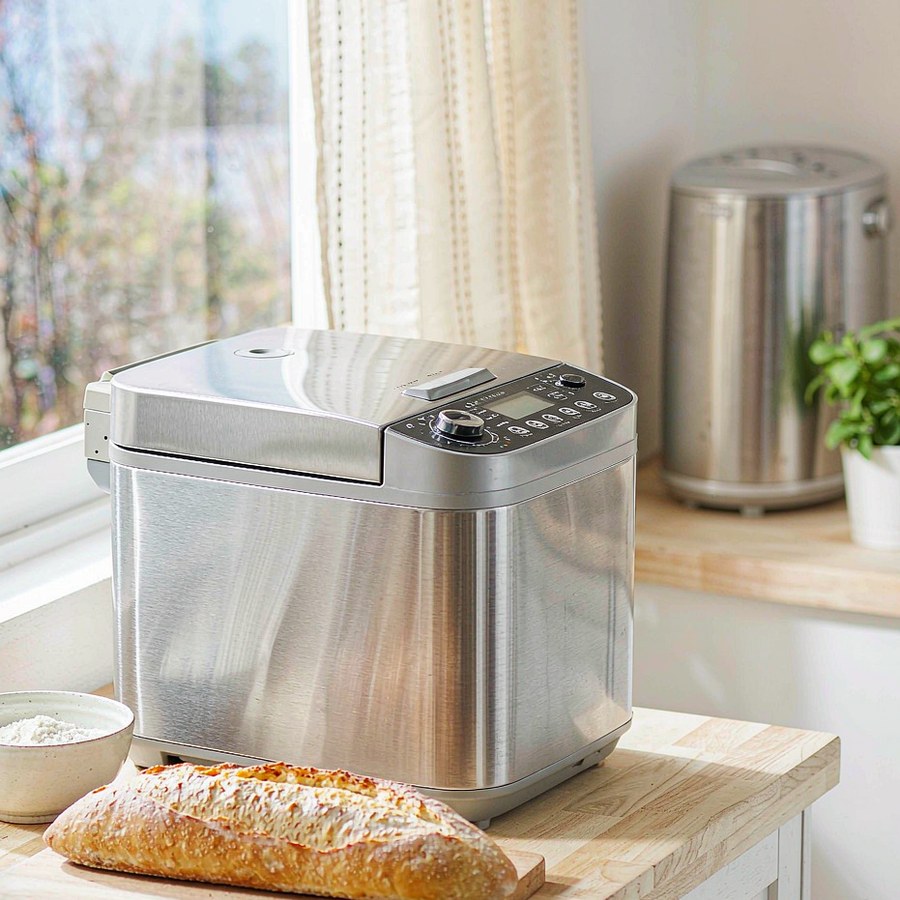
Bench space and the 4 inch clearance rule
The body measures 13 inches deep by 10 inches wide by 11 inches tall. That is 0.90 square feet of counter, against 1.33 square feet for a 6 quart slow cooker.
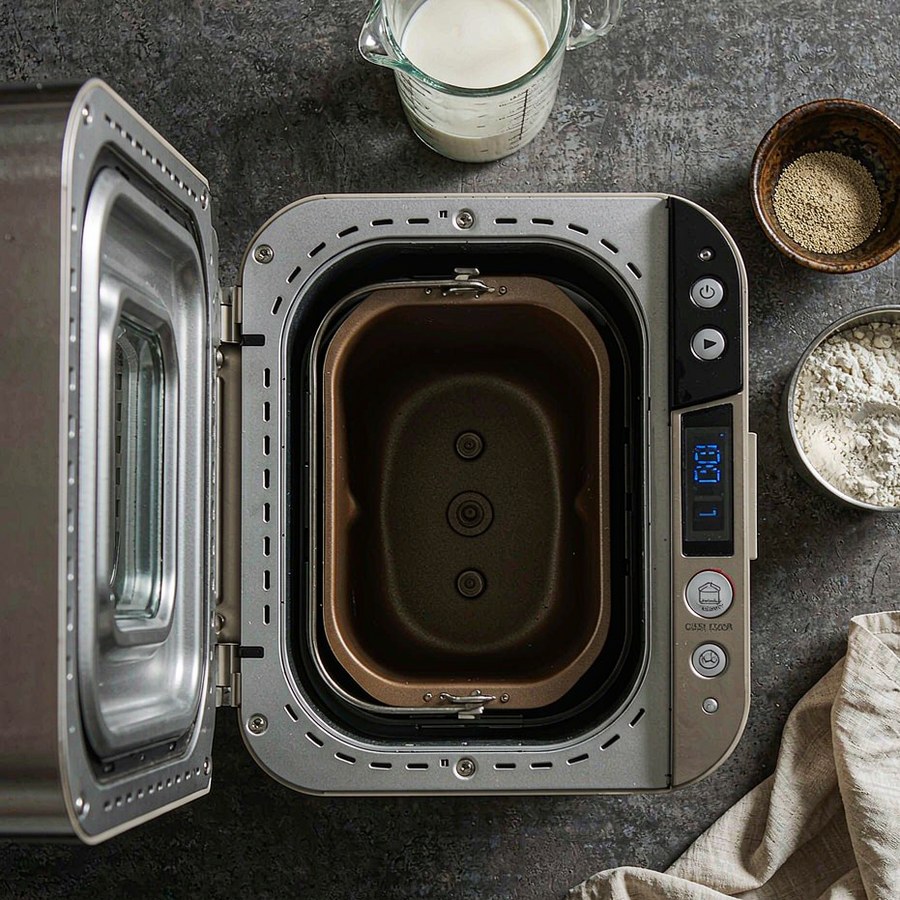
Height is the constraint most buyers miss. The lid hinges upward and the pan lifts out vertically, so a wall cupboard at 14 inches above the counter will block the routine.
Manufacturer guidance asks for 4 to 6 inches of clearance on every side. Steam vents from the top during the bake, and a machine pushed against a splashback will mark it.
Weight decides where it lives permanently. At 8.9 pounds empty it is light enough to move, but loaded with dough and a hot pan it is a two hand lift.
Wattage, circuits and the 1.3 metre cord
Both machines draw 650 watts at 120 volts, which is about 5.4 amps. On a 15 amp kitchen circuit that leaves room for a kettle but not for a toaster and a microwave at the same time.
Compare that with a 700 watt pressure cooker or a 1500 watt air fryer and the bread maker looks modest. The difference is duration rather than peak load, because it holds its draw for hours instead of minutes and a machine left alone on a shared circuit with a kettle and a microwave will trip the breaker at the wrong moment.
The cord measures 1.3 metres, or 4.3 feet. A socket behind the machine is awkward; one to the side is workable. An extension lead is a poor answer for a heat appliance left unwatched.
A second countertop appliance raises the same question about bench budget, and the countertop cooking guide works through how much space a second unit really costs.
What the presets genuinely cover
Twenty-one programmes sounds like twenty-one loaves. In practice the menu splits into a handful of dough types, three crust shades and a delay timer.
Light, medium and dark adjust the final bake rather than the recipe. Choosing dark on a sweetened dough will scorch the crust before the centre sets.
Jam, yoghurt and cake cycles appear on this model class, and the honest verdict is mixed. A cake programme produces a dense bake with an odd crumb because the pan is shaped for a loaf. Treat these as extras.
The delay timer is the one feature that changes a routine. It runs to 12 hours, so a load set the night before finishes before breakfast. Fresh milk and eggs in the pan for twelve hours is the risk no manual resolves.
Cleaning, and the parts that fail first
The bread pan is non-stick and lifts out, and the kneading paddle comes free with it. Neither is dishwasher safe, and the coating scratches if it meets a scouring pad.
The paddle shaft is the part that fails. Flour hardens inside the collar, the paddle starts to drag, and the loaf comes out with a hollow base. A warm soak after every bake prevents it.
Stainless steel wipes clean but shows fingerprints. The black control panel collects flour dust in the button gaps, which is cosmetic and never fatal.
What a bread maker cannot do
A bread maker will not produce a sourdough with a proper open crumb. The pan confines the dough and the fixed cycle cannot respond to a starter that is slow or fast on the day.
It is also not a stand mixer. A 650 watt motor turns a single paddle at one speed, and it cannot cream butter or whip egg whites. Anyone buying it for those jobs has the wrong tool.
Shape is the other hard limit. Every loaf comes out as a rectangular block, so baguettes, boules and flatbreads stay in the oven. Buyers who want those shapes should spend the money on a Dutch oven instead.
Noise is modest but constant. The paddle turns for the first twenty minutes, and on a quiet open plan floor that is audible.
Checklist
- Count the people at the table.
- Measure the counter and the cupboard above it, because the lid needs vertical space to hinge open and the pan lifts straight up.
- Confirm the outlet reaches.
- Read the clearance guidance, since 4 to 6 inches on every side is the difference between a clean splashback and a marked one.
- Decide whether jam and yoghurt cycles matter, and accept that they are extras rather than reasons to buy.
- Buy a second pan if the household bakes more than twice a week.
Every figure above comes from the specification block on each product page. Read the capacity, wattage, weight and dimensions before ordering, then measure the counter and the cupboard above it once more. If the lid has nowhere to open, no programme list will fix it.
More buying guides
- Mirror Weight and Wall Fixings: What Holds 20 lb of GlassMirror Weight & Wall Fixings
Mirror weight decides which fixing you need long before size matters. Thirteen models run from 5.1 lb to 20 lb, and only seven publish a weight at all. Read the Included Components line before the drill comes out.
6 min read
- A 10 in Shower Head and a 51 in Faux Tree in One BathroomBathroom Corner Reach
A shower set that reaches 15 in from the wall and a 51 in artificial tree that spreads 27 in from a small pot. Both are decided by reach rather than footprint, and both need two measurements before either goes in the cart.
6 min read
- Baby Gate and Tree Swing: Height, Opening Width and LoadToddler Gate & Garden Swing
A 36 inch baby gate fits openings from 30 to 40.5 in and stands 35.63 in tall, while a 40 inch saucer swing carries 440 lb on ropes that adjust from 33.5 to 63 in. Both need one measurement before the order: the doorway gap for the gate, and a sound branch for the swing.
7 min read
- Desk Chair, Tower Heater and Mini Cooler for a Spare RoomSpare Room Workspace
Three appliances turn a spare room into a place to work: a swivel chair that needs 4.7 sq ft of floor, a 1,500 W tower heater that fills most of a 15 A circuit, and a 4 litre cooler that is not a fridge. Every size and wattage here comes from the product pages.
7 min read
- Clamp-On Forks, Hitch Adapters and Bench Kit: Fit and WeightYard Attachments & Bench Kit
Four tools that all have to fit something already owned: clamp-on pallet forks, a Category 1 hitch adapter, a 330-piece tool case and a 550 W heat press. The listing fields decide each one.
5 min read
- Automatic Pet Feeders and Travel Carriers: Capacity and FitPet Feeding & Travel
Two automatic feeders and two ways to move a pet, compared on the fields that decide the purchase: hopper litres, body weight, footprint and cable run. The numbers favour the larger hopper for two cats and the hard carrier for a small boot.
5 min read